
What Is Handmade Jewelry? (And What It Really Means)
Posted by Chandan Tolaney on Apr 8th 2026
Handmade Jewelry – How to Recognize It, and Why It Matters
Some jewelry is made. Some jewelry is crafted. At first glance, it can be hard to tell the difference. Both can shine, both can follow trends, and both can look beautiful on a display. But when you put on a piece of handmade jewelry, something shifts. There is a subtle sense of character — a feeling that the piece carries more than design. It carries intention, process, and the quiet imprint of a human hand.
So what does "handmade" actually mean in the context of jewelry? And why does it feel different to wear?
What Handmade Jewelry Actually Means
What is considered handmade jewelry?
Handmade jewelry refers to pieces created with meaningful artisan involvement — rather than being fully mass-produced by machines. Tools, molds, or casting methods may still be part of the process, but the defining element is a human being making real decisions about how the piece is shaped, finished, assembled, or brought to life.
Unlike factory jewelry produced in large volumes with uniform, machine-controlled precision, handmade pieces are typically made in smaller batches and carry the marks of individual craftsmanship. The goal is not perfect replication. It is presence.
What is handmade jewelry?
Handmade jewelry is jewelry made with meaningful artisan involvement in the creation process. That may include hand-beading, hand assembly, hand-finishing, or small-batch workshop production — as opposed to fully machine-driven mass manufacturing where human involvement is minimal.
Can molded or cast jewelry still be considered handmade?
Yes — and this is one of the most misunderstood aspects of the category. A piece can begin with a mold or cast form and still be genuinely handmade if artisans are deeply involved in what comes next. Zamak jewelry, for example, may begin with a cast form, but the finishing, polishing, plating preparation, assembly, and fine detailing are typically done by hand in artisan workshops. That process is very different from industrial jewelry production, where uniformity is machine-controlled from beginning to end.
Can cast or molded jewelry be handmade?
Yes. A piece can start with a mold or cast form and still be considered handmade if artisans are meaningfully involved in the finishing, detailing, polishing, plating prep, assembly, and final construction. What matters is the degree of human craft in the process — not whether any tools or molds were used.
What Counts as Handmade — and What Doesn't
The term "handmade" can mean different things depending on the material and technique, so it helps to look at the full process rather than just one step. The question is not whether any machinery was involved. The question is how much of the piece was shaped, decided, and finished by a person.
| Typically considered handmade | Not truly handmade |
|---|---|
| Hand-beaded necklaces and bracelets | Jewelry fully machine-produced in large factories with little artisan involvement |
| Jewelry assembled by artisans using small-batch methods | Bulk items made for speed and sameness rather than craft |
| Hand-forged or hand-shaped metal details | Products labeled "handmade" when only the packaging or final handling was done by hand |
| Pieces polished, plated, finished, or detailed by hand | Designs where no artisan decision-making occurs at any stage of production |
| Cast or molded pieces that are hand-finished and assembled in workshop settings | Mass-market replicas of artisan styles with no craft involvement |
Many authentic artisan-made pieces exist in the middle ground. A mold may be used. A casting may be involved. But what matters is that the process does not end there — that a person's hands, judgment, and care are still part of what makes the piece what it is.
"Handmade jewelry is not defined by the absence of machines. It is defined by the presence of something else — care, intention, and the quiet imprint of the people who made it."
Handmade Jewelry Can Honor Tradition — Or Create New Ones
When people hear the phrase "artisan jewelry," they often picture only ancient techniques passed down through generations. That is certainly part of the story. But it is not the whole one.
Does handmade jewelry always come from old traditions?
No — and this distinction matters. Some handmade jewelry grows from inherited techniques carried across families and regions for centuries. Other jewelry reflects new traditions being born: artisans adapting handcraft into new materials, new values, and new ways of making that didn't exist a generation ago.
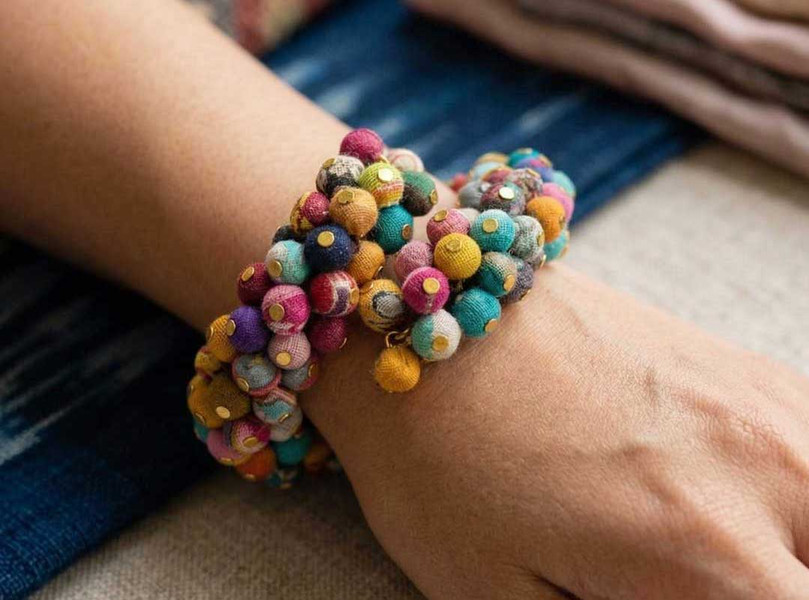
Recycled textile bead jewelry is a beautiful example. It draws on familiar hand-wrapping and bead-assembly methods, but it also reflects a more contemporary mindset — one shaped by color, reinvention, sustainability, and creative reuse of materials that would otherwise be discarded. That too is artisan work. That too is meaningful craft. Handmade jewelry does not have to come only from old traditions. Sometimes it is the beginning of a new one.
Does handmade jewelry always come from old traditions?
No. Some handmade jewelry is rooted in generations of cultural craft. Other pieces reflect newer creative traditions — such as recycled textile jewelry, contemporary artisan metalwork, and design methods that combine traditional hand-skill with modern materials and values. Both are legitimate forms of artisan craft.
Why Handmade Jewelry Feels Different to Wear
There is a reason handmade jewelry often feels more personal. It is not just about how it looks. It is about how it was made — and by whom.
Each piece carries the rhythm of the maker's hands, the choices made along the way, and the slight variations that make it feel alive. These details are not flaws. They are often what give a piece its warmth, texture, and individuality. When you wear handmade jewelry, you are not wearing something replicated thousands of times with identical results. You are wearing something that was formed, adjusted, finished, and assembled with care.
Why does handmade jewelry cost more than mass-produced jewelry?
Because it involves more of everything that takes time: more labor, more individual decisions, smaller production runs, and more skilled attention at each stage of making. A factory can produce hundreds of identical pieces per hour. An artisan might spend that same hour finishing a dozen — each one slightly different from the last. That difference in process is what you are paying for, and what you are wearing.
Why does handmade jewelry cost more?
Handmade jewelry typically costs more because it involves more skilled labor, smaller production runs, and greater individual attention at each stage than factory-made jewelry produced at industrial scale. You are paying for the time, skill, and craft decisions that went into each piece.
"Each piece carries the rhythm of the maker's hands and the choices made along the way. These variations are not flaws — they are often what give the piece warmth, texture, and a feeling of being genuinely alive."
What role does the artisan play in handmade jewelry?
Behind every handmade piece is a person making real decisions — about proportion, finish, balance, texture, and detail. In some cases that work is rooted in long-standing regional craft traditions. In others, it is shaped by new design ideas, experimental materials, or a more contemporary creative voice. Both matter. From hand-strung statement necklaces to metal pieces finished in small workshops, handmade jewelry reflects individual artistry and a human relationship to materials. That connection between maker and object is what gives the piece its depth.
Imperfection as a Mark of Authenticity
In mass production, consistency is the goal. In handmade work, variation is natural — and often meaningful.
You may notice slight differences in bead shape or spacing. Small variations in texture or finish. Subtle irregularities in color, wrapping, or alignment. These are not signs of carelessness. They are signs that a piece was shaped by hand rather than stamped for identical repetition. Over time, many people come to value these differences for exactly that reason: they make the jewelry feel more grounded, more real, and more personal. They are evidence of a human being working with care.
Handmade jewelry also tends to allow materials to remain visible and expressive in ways that industrial production often removes. Natural stone, wood, horn, woven textile, wrapped bead — because the process is less controlled, the final piece retains more texture and character. That gives handmade jewelry a more tactile, soulful presence than highly standardized production.
How to Recognize Handmade Jewelry
Whether you are shopping online or in person, certain details point toward genuine artisan work. They are not always obvious at first — but once you know what to look for, they become easier to find, and more meaningful to understand.
- Slight variation from piece to piece. No two are identical. Even small differences in color, finish, or proportion are signs of a human hand at work.
- Visible texture and organic irregularity. Handmade pieces tend to show their materials. Stone that isn't perfectly uniform. Beads that sit at slightly different angles. Metal with the marks of hand-finishing.
- Transparency about origin and process. Makers and brands who genuinely work with artisans tend to tell you so — specifically. Country of origin, material sourcing, craft tradition.
- Small-batch availability. Handmade pieces run out. They are not restocked in days. If a piece is always available in unlimited quantity, it likely wasn't made by hand.
- Thoughtful finishing on the back and underside. Factory jewelry often has rough, unfinished reverse sides. Artisan-made pieces tend to show care even where no one is looking.
- A story you can trace. The best handmade jewelry comes with a traceable origin — a maker, a region, a technique you can look up and understand.
Over time, these details become easier to recognize. And often, more meaningful to wear.
A More Thoughtful Way to Wear Jewelry
Choosing handmade jewelry is often less about chasing trends and more about finding pieces that resonate. It invites a different way of dressing — one shaped by personal taste, story, culture, and appreciation for how things are made. Less accumulation. More intention.
And sometimes that shift in how you think about what you wear is where the real value lives — not in the price, but in the meaning behind the object, and the person who made it.
"Handmade jewelry does not have to come only from old traditions. Sometimes it is the beginning of a new one."
Cultural Elements works with artisan makers across different materials, techniques, and craft traditions — from long-established cultural jewelry lineages to newer forms of handmade design. What connects them is the human element behind each piece. Explore the collection at culturalelements.com.