
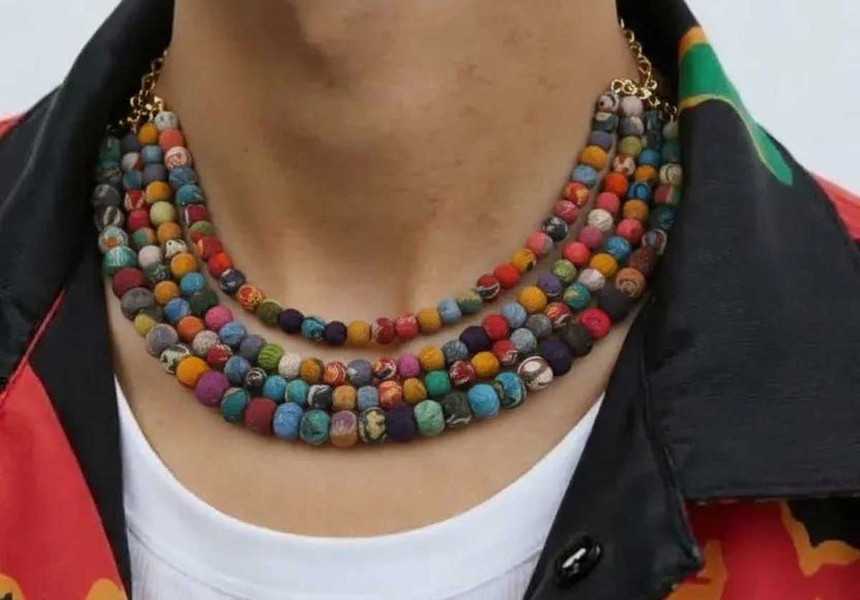
Handmade vs. Mass-Produced Jewelry
Posted by Chandan Tolaney on Apr 8th 2026
What's the Real Difference?
At a glance, they can look exactly the same. A polished metal finish. A well-balanced design. A piece that catches your eye across a display. Whether it's handmade or mass-produced, jewelry today can look equally refined on the surface.
But the difference isn't always in how it looks. It's in how it comes to life. And once you understand that distinction, it changes how you see — and choose — what you wear.
The Core Distinction: Process and Scale
What is the difference between handmade and mass-produced jewelry?
The simplest way to understand it is this: handmade jewelry is created with direct artisan involvement — often in small batches, with care given to shaping, finishing, and assembly at each stage. Mass-produced jewelry is manufactured in large quantities using automated machinery, engineered for uniformity and speed above all else.
But that's just the surface of it. The real difference shows up in how each piece is made, how it feels to wear, and what it represents — both to the maker and to you.
What is the difference between handmade and mass-produced jewelry?
Handmade jewelry involves meaningful artisan involvement in shaping, finishing, or assembling each piece — often in small batches. Mass-produced jewelry is manufactured at industrial scale using automated machinery, prioritizing identical repetition and high volume over individual craft. The core difference is not just how they look, but how they are made and what that process leaves behind in each piece.
How Each One Is Made
The production process is where the two diverge most clearly — not always in the tools used, but in the degree of human decision-making that shapes the final result.
| Handmade jewelry | Mass-produced jewelry | |
|---|---|---|
| Production | Small batches or individual pieces; artisan-led at every stage | Large-volume automated manufacturing; identical output at scale |
| Finishing | Polished, plated, assembled, and detailed by hand | Machine-polished for uniform smoothness; consistent across units |
| Human role | The artisan makes real decisions about proportion, texture, and detail | Machine executes the design; human involvement is minimal post-setup |
| Materials | Natural variation retained — stones, textures, and finishes remain expressive | Uniformity prioritized — color, surface, and shape are standardized |
| Time per piece | Slower; more time, attention, and skill invested in each item | Faster; volume is the goal, time-per-unit is minimized |
| Variation | Slight differences between pieces — signs of the human process | Pieces are designed to be identical; variation is considered a defect |
"In mass production, consistency is the goal. In handmade work, variation is not a flaw — it is evidence of a human being working with care."
Can Jewelry Be Both? The Hybrid Middle Ground
Can jewelry be both handmade and mass-produced?
Yes — and this is one of the most nuanced aspects of the category, often misunderstood by buyers and misused by brands. Some jewelry genuinely combines both approaches: a molded or cast form as a starting point, followed by meaningful artisan involvement in everything that comes after.
Zamak jewelry is a good example. A cast form begins the process — but the finishing, polishing, plating preparation, hand-assembly, and fine detailing are typically carried out by artisans in workshop settings. That hybrid process still carries real elements of handmade craftsmanship. It is very different from jewelry where automation handles every stage and a human hand never meaningfully touches the piece.
What matters is not whether any tools or molds were involved. It's the degree to which a person's skill, judgment, and care shaped the final result.
Can jewelry be both handmade and mass-produced?
Yes. Some jewelry combines both processes — beginning with a cast or molded form, then involving artisans in finishing, polishing, assembly, and detailing. This hybrid approach still carries genuine handmade craftsmanship. What matters is not whether any machinery was used, but how much human skill and decision-making shaped the final piece.
Why Handmade Jewelry Feels Different to Wear
The difference between the two isn't only visible — it's tactile. Handmade jewelry often carries subtle variation in form, texture, and balance that makes each piece feel more personal. The slight asymmetry in a bead. The texture left by a hand-finished surface. The weight of a stone that wasn't machine-sorted for uniformity. These aren't imperfections. They are what make the piece feel alive.
Mass-produced jewelry is designed to feel the same every time — predictable, standardized, and consistent across thousands of units. That's not a criticism. For some purposes, that consistency is exactly what's needed. But it's a different experience from wearing something formed by human hands that made real choices along the way.
"When you wear handmade jewelry, you are not wearing something replicated thousands of times. You are wearing something that was formed, adjusted, and finished with care — by a specific person, in a specific place."
Why does handmade jewelry cost more than mass-produced jewelry?
Because it involves more of everything that takes time. More skilled labor. More individual decisions per piece. Smaller production runs that can't benefit from economies of scale. And more attention at each stage of making — finishing, assembly, detailing — that automated production removes entirely. A factory might produce hundreds of identical pieces per hour. An artisan working by hand might finish a dozen in that same time, each one slightly different from the last. That difference in process is what you're paying for. And, in most cases, what you're wearing.
Why is handmade jewelry more expensive than mass-produced jewelry?
Handmade jewelry costs more because it involves greater skilled labor, smaller production runs, and more time and individual attention per piece than factory-made alternatives. Each artisan decision — about finishing, proportion, texture, and assembly — adds time that industrial production eliminates. You are paying for craft, not just materials.
Does One Last Longer Than the Other?
Does handmade jewelry last longer than mass-produced jewelry?
It depends — on materials, on construction, and on how a piece was made. Handmade jewelry crafted from sterling silver, solid brass, or quality gemstones with careful finishing can last decades. But "handmade" alone is not a guarantee of durability. A poorly assembled handmade piece can fail just as quickly as a cheap factory-made one.
What handmade work often does better is allow for individual attention to structural details — clasps, joints, settings — that factory lines sometimes rush through. And when materials of character are used rather than the cheapest available substrate, the result tends to age more gracefully. Patina becomes personality. Wear becomes part of the story.
Does handmade jewelry last longer than mass-produced jewelry?
Not automatically — durability depends on materials and construction quality, not production method alone. However, handmade jewelry crafted with quality materials and careful artisan attention to structural details often ages better than fast-fashion alternatives. The honest answer: look at what it's made from and how it was assembled, not just how it was labeled.
How to Decide What's Right for You
Neither handmade nor mass-produced jewelry is inherently better. They serve different purposes, and the right choice depends on what you're looking for. These questions can help you find your answer.
Is handmade jewelry better than mass-produced jewelry?
Not categorically — but it is different in ways that matter to many people. Handmade jewelry typically offers greater individuality, artisan character, and traceability. Mass-produced jewelry offers consistency, availability, and lower price points. The better question is what you value in a piece you are going to wear.
Why do handmade jewelry pieces vary from each other?
Because they are shaped and finished by human hands. When a person — not a machine — is making decisions about a piece at each stage, small differences naturally emerge: in texture, in spacing, in how a finish catches the light. These variations are not defects. They are evidence of the handmade process.
Can you tell if jewelry is handmade just by looking at it?
Sometimes. Signs include slight variation from piece to piece, visible texture or organic irregularity, thoughtful finishing on both the front and back of a piece, and natural material characteristics that haven't been machine-smoothed away. But the most reliable approach is transparency from the maker — look for brands that tell you specifically where a piece was made, by whom, and how.
Is all artisan jewelry handmade?
Most artisan jewelry involves significant handmade elements, but the terms are not identical. "Artisan" refers to the craft tradition and the skill of the maker. "Handmade" refers to the production process. A piece can be genuinely artisan-made while incorporating some tools, molds, or casting — what matters is meaningful human involvement in shaping and finishing the final result.
How can I tell if a brand is genuinely selling handmade jewelry?
Look for specificity: named countries of origin, named artisan communities or workshops, descriptions of technique, and small-batch or limited-stock availability. Vague claims like "artisan-inspired" or "handcrafted feel" without supporting detail are often marketing language rather than production reality. Genuine handmade brands tend to tell you the story because they are proud of it.
The difference between handmade and mass-produced jewelry isn't always visible at first glance. One is built for repetition. The other is shaped through process — through the decisions, adjustments, and care of a person who made something with their hands. And sometimes, that process is what gives a piece its meaning. Not just its value. Its meaning.
Cultural Elements works with artisan makers across different materials, techniques, and craft traditions — from long-established cultural jewelry lineages to newer forms of handmade design including recycled materials and contemporary workshop techniques. What connects every piece is human involvement, not just mechanical production. Explore the collection at culturalelements.com.