
The Story Behind Artisan Jewelry
Posted by Chandan Tolaney on Apr 8th 2026
What Happens Before It Reaches You
Every piece begins somewhere you don't see. Before it reaches a shelf, a website, or a box at your door, it exists in a different setting entirely — a small workshop in Jaipur, a shared table in Istanbul's Grand Bazaar district, a cooperative in the highlands of Guatemala. Not a factory line. Not a system optimised for speed. Just a process: shaped by hands, by decisions made in real time, and by the particular knowledge a person has built up through years of working with a specific material in a specific place.
That origin is invisible by the time the piece reaches you. But it is not gone. It is still there — in the texture of the finish, the way the piece moves, the slight variation that marks it as something made rather than manufactured. Understanding what artisan jewelry actually is, and what happens before it arrives, changes how you see and value what you wear.
What Artisan Jewelry Actually Means
What is artisan jewelry?
Artisan jewelry is jewelry made or meaningfully finished by skilled makers — people who bring craft knowledge, material understanding, and direct human involvement to the process of creating each piece. It is typically produced in small workshops or cooperative settings rather than large automated factories, and it reflects the skill, sensibility, and cultural context of the people who make it.
The term covers a wide range of work: hand-beaded pieces assembled bead by bead, metalwork shaped and finished by hand in a silversmith's workshop, textile jewelry built from recycled cloth wrapped onto handmade forms. What connects all of these is not a single technique but a shared condition — that a skilled person's hands, judgment, and knowledge are central to the outcome of every piece.
What is artisan jewelry?
Artisan jewelry is jewelry made or finished by skilled craftspeople working in small workshops or cooperative settings, rather than mass-produced by automated factory systems. It reflects material knowledge, craft skill, and meaningful human involvement at each stage of making — from material selection through finishing and assembly. The term covers both traditional craft traditions and contemporary handmade approaches.
From Raw Material to Finished Piece: What the Process Looks Like
How is artisan jewelry made?
The process varies by material and technique, but every piece of artisan jewelry moves through a sequence of stages — and at each stage, in an artisan setting, a person is making real decisions rather than deferring to a machine.
It begins with material selection. A silversmith chooses sheet metal for its particular weight and purity. A bead-maker selects natural stones for their specific color depth and surface character. A textile jewelry maker evaluates fabric for its texture, density, and how it will behave when wrapped. These are not incidental choices — they shape everything that comes after.
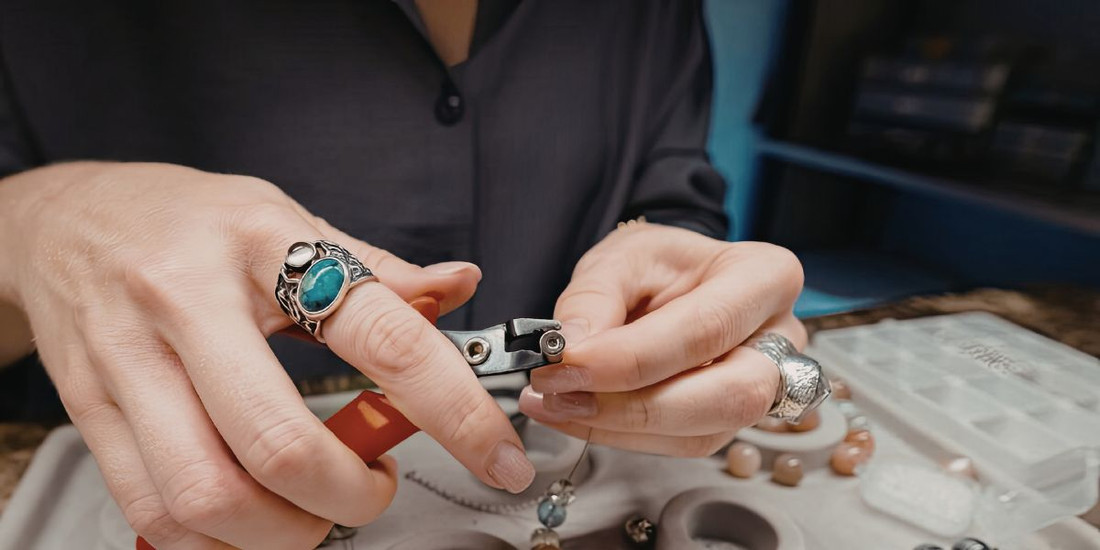
From there, the material is worked: cut, shaped, cast, hammered, strung, wrapped, or woven depending on the technique. In artisan settings, this stage is where skill shows most clearly. A hand-hammered metal surface looks and feels different from a machine-polished one. Beads strung by hand sit differently than those threaded by machine. The variation that results is not inconsistency. It is the record of a person responding to the material in front of them.
Then comes finishing — polishing, plating, assembly, quality check — and here too, in a genuine artisan context, human hands are present. The piece is examined, adjusted, and completed by someone who knows what the finished result should look and feel like. Not a machine measuring against a tolerance. A person deciding whether it is ready.
"At each stage, a person is making real decisions — not deferring to a machine. That process is invisible by the time the piece reaches you. But it is still there, in everything you can feel."
| Stage of making | What the artisan brings |
|---|---|
| Material selection | Knowledge of how a specific material will behave — its weight, texture, how it ages and responds to finishing |
| Shaping and forming | Skill built through repetition — the ability to read what the material needs rather than forcing a uniform result |
| Finishing and detailing | Judgment about when a piece is complete — a standard held in the mind and hands of a person, not a calibrated machine |
| Assembly | Spatial understanding of how elements sit together, move together, and feel when worn — informed by experience with the body |
Tradition and Adaptation: The Full Spectrum of Artisan Work
Is artisan jewelry always traditional?
No — and this is one of the most common misconceptions about the category. Artisan jewelry spans a wide spectrum, from techniques that have been practiced in the same region for centuries to approaches that are entirely contemporary in their materials, values, and aesthetic sensibility.
On one end, you have craft traditions with deep roots: the lost-wax casting practiced by brass workers in West Africa, the filigree silversmithing of Bali, the Kantha bead-wrapping of India, the intricate beadwork of Guatemala's highland cooperatives. These techniques carry cultural meaning as well as craft skill — the design vocabulary of a piece can communicate identity, region, status, or belief to those who know how to read it.
On the other end, newer forms of artisan work are emerging that draw on handcraft methods but apply them to contemporary problems. Recycled textile jewelry is a good example: pieces built from salvaged and repurposed fabric scraps, wrapped and assembled by hand, carrying the craft logic of traditional bead-making but serving a distinctly modern sensibility around color, reinvention, and material sustainability. This is not a departure from artisan values. It is an extension of them — craft adapting, as it always has, to the moment it finds itself in.
Is artisan jewelry always rooted in traditional craft?
No. Artisan jewelry spans from centuries-old regional craft traditions to contemporary handmade approaches that use new materials and reflect modern values. Both are genuine artisan work — what defines them is skilled human involvement in the making process, not how old the technique is. Craft has always adapted, and its newest forms carry the same intention as its oldest ones.
A Global Language, Spoken in Different Dialects
Artisan jewelry is made everywhere — but it does not look or feel the same everywhere. Each region brings its own materials, its own design vocabulary, and its own relationship to the craft traditions it works within. Understanding those regional differences is part of understanding what a piece actually is.
Indian artisan jewelry draws on extraordinary material diversity — from Kantha textile beads made by women's cooperatives in West Bengal, to gemstone settings from Jaipur's centuries-old lapidary tradition, to recycled brass and copper work from across Rajasthan. The craft culture is deeply regional, with distinct techniques, materials, and aesthetics varying by state and community.
Turkey's position at the crossroads of Asia and Europe has produced a jewelry tradition of unusual richness. Istanbul's Grand Bazaar has been a center of metalworking for centuries, and Turkish artisans are known for intricate filigree work, Zamak casting with hand-finishing, and distinctive use of colored stones set in oxidised silver. Ottoman design vocabulary — geometric patterns, crescent forms, and layered ornamentation — runs through both traditional and contemporary pieces.
Latin American artisan jewelry ranges from the seed and natural material work of Ecuador and Colombia — where Tagua nut, tropical seeds, and rainforest materials are shaped and assembled by hand — to the intricate seed bead weaving of Guatemala's Maya cooperatives, where patterns carry direct lineage to pre-Columbian design traditions. Many pieces are produced through fair trade cooperatives that provide sustainable income to artisan communities.
Across all of these regions and traditions, one thing remains constant: the presence of the maker. A specific person's knowledge, skill, and decisions are embedded in every piece — in the material chosen, in the technique applied, in the finishing choices that complete the work. That is the thread that connects a Kantha bead earring from Kolkata to a Tagua disc necklace from Manta to a hammered silver ring from Istanbul.
"Each region brings its own materials, its own design vocabulary, its own relationship to craft. What connects them is not technique or tradition — it is the presence of the maker in every piece."
Skill Built Through Time and Repetition
How do artisan jewelry makers develop their skills?
Through time, repetition, and material knowledge accumulated through direct experience. This is not a romantic notion — it is a practical reality of how craft skill works. You cannot learn to read a piece of silver, or understand how a natural stone will behave under a setting tool, or know when a textile bead wrap is tight enough to hold but loose enough to drape, without having done it hundreds of times.
In many artisan traditions, this knowledge is passed directly: a younger maker works alongside an experienced one, learning through observation and repetition before working independently. In others, it is developed through formal training in craft cooperatives or workshops. Either way, the skill that ends up in a finished piece represents years of accumulated practice — of mistakes made, adjustments learned, and standards internalised until they become instinct.
This is part of why artisan jewelry costs more. You are not just paying for materials and time. You are paying for the knowledge that makes the time productive — the expertise that turns raw materials into something worth wearing.
Why does artisan jewelry cost more than mass-produced jewelry?
Because it involves skilled human labor — not just time, but expertise built through years of practice — along with smaller production runs, more individual attention per piece, and often higher-quality or more characterful materials. You are paying for the knowledge, judgment, and craft skill embedded in the piece, not just the cost of its components.
The Connection That Remains
When a piece of artisan jewelry reaches you, the maker is long gone — back at the workbench, working on the next piece. But something of the process remains. It is present in the texture of a hand-finished surface. In the slight variation that marks the piece as individual rather than mass-produced. In the weight and warmth of materials that were chosen, not just sourced.
You do not need to know every detail of where a piece came from or who made it for this to register. Most people sense it without being able to name it — a quality of attention, of care, of something having been made rather than output. That sense is not imaginary. It has a physical basis in every decision that was made along the way. Knowing more about those decisions simply gives you a language for something you were already feeling.
- You don't need the full story. Knowing that skilled hands and real time went into a piece is often enough to change how you experience wearing it.
- The origin is in the object. Variation in texture, finish, and form are not flaws — they are the physical record of the artisan process, present in the piece whether or not you know to look for them.
- Craft is not only heritage. Contemporary artisan work — recycled material jewelry, mixed-media pieces, modern workshop design — carries the same intention and human presence as traditional forms.
- The maker's knowledge is part of what you own. The skill embedded in a well-made artisan piece represents years of practice. That expertise shows in the result, even when you can't see exactly how.
Is artisan jewelry always handmade?
Usually, though the two terms are not identical. Artisan jewelry always involves meaningful human skill and involvement in the making process — but tools, molds, and casting methods may be part of that process. A piece that begins with a cast form and is then hand-finished, assembled, and detailed by a skilled maker is genuine artisan work, even though it involved a mold at one stage. What matters is the degree of craft knowledge and human involvement, not whether any equipment was used.
How can you tell if jewelry is genuinely artisan-made?
Look for specificity rather than vague claims. Genuine artisan brands tend to name the country or region of production, describe the technique or material tradition, and show the kind of slight variation — in texture, finish, or form — that is a natural outcome of handcraft. Phrases like "artisan-inspired" or "handcrafted style" without supporting detail are often marketing language rather than production reality. If a brand is proud of where and how its pieces are made, it will tell you clearly.
Does artisan jewelry support the makers who produce it?
It depends on how it is sourced. Well-structured artisan partnerships — particularly those working through fair trade frameworks or direct cooperative relationships — provide makers with stable income, fair pricing, and dignified working conditions. These arrangements matter: the same craft skill can be extracted cheaply or compensated fairly, and the difference affects both the maker's livelihood and, often, the quality and care that goes into the work. When sourcing matters to you, look for brands that are transparent about their supplier relationships.
What is the difference between artisan jewelry and ethnic jewelry?
The terms overlap but are not the same. "Artisan jewelry" describes a production method — skilled human craft involvement. "Ethnic jewelry" is a looser cultural descriptor that refers to pieces inspired by or originating from specific cultural traditions. Artisan jewelry from a specific region will often carry cultural design elements — but not all artisan jewelry is "ethnic" in style, and jewelry described as ethnic is not always genuinely artisan-made. The first term tells you about how something was made; the second tells you (approximately) where its aesthetic comes from.
Can artisan jewelry be modern in style?
Absolutely. Artisan craft has never been static — it has always adapted to new materials, new contexts, and new aesthetic sensibilities. Contemporary artisan jewelry includes pieces made from recycled textiles, mixed natural and industrial materials, and design approaches that are entirely modern in their visual language while still being made by hand in workshop settings. The craft tradition and the contemporary moment are not in opposition. They are in ongoing conversation.
Artisan jewelry carries something beyond design. A process. A set of hands. A sequence of decisions made by someone who knew the material well enough to coax something out of it worth keeping. You don't need to trace every step to feel it. The piece carries the evidence of its own making — and that, in the end, is often what gives it depth.
Cultural Elements sources from artisan groups and workshops across India, Turkey, Latin America, and beyond — working with makers whose craft reflects both long-standing regional traditions and newer forms of handmade design. Every piece in our collection carries the presence of the person who made it. Explore at culturalelements.com.